Market Update August 2026: Quiet Resilience
Markets delivered solid gains through the 2025/2026 financial year despite geopolitical disruption, as resilient economic growth and broadening corporate earnings proved more influential than the headlines.
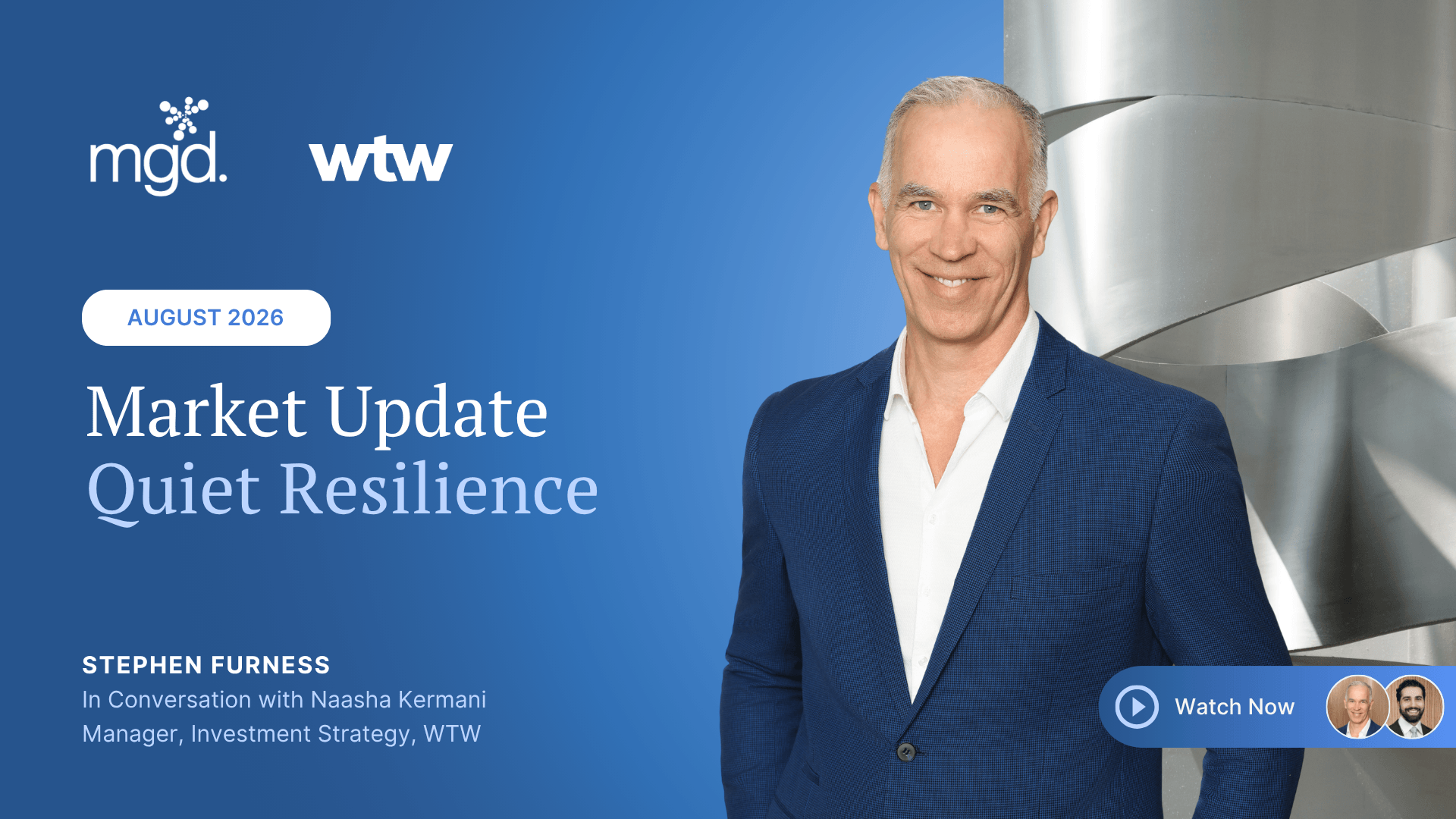
In this August 2026 Market Update, Stephen Furness, Director of MGD Wealth and Chair of the MGD Investment Strategy Group, is joined by Naasha Kermani, Manager in the Investment Strategy team at WTW, to review the 2025/2026 financial year and consider the forces shaping the outlook—from persistent domestic inflation and interest rates to the next phase of artificial intelligence investment.
Key Takeaways
Fundamentals outweighed uncertainty. Resilient growth and strong earnings supported global equity markets despite geopolitical conflict, energy-market volatility and renewed inflation concerns.
Australia remained positive but lagged. Australian equities returned around 6 per cent over the 2025/2026 financial year, with weaker economic growth, higher interest rates, housing weakness and limited exposure to the AI investment cycle contributing to underperformance.
Market leadership broadened. Emerging markets benefited from semiconductor-heavy economies such as South Korea and Taiwan, while global listed property also produced strong returns.
Australia’s policy outlook remains finely balanced. With core inflation at around 3.6 per cent and domestic activity slowing, WTW expected the Reserve Bank of Australia to keep the cash rate at 4.35 per cent through the remainder of 2026, with the path in 2027 dependent on inflation, employment and household demand.
AI remains a multi-year investment theme. The United States is beginning to see productivity benefits beyond the technology sector, but broader gains in Australia are not yet evident.
• Diversification remains central. WTW retained a constructive, pro-risk stance while emphasising global diversification and multiple return drivers given ongoing geopolitical and inflation risks.
2025/2026: Resilience Beneath the Headlines
The 2025/2026 financial year was marked by geopolitical uncertainty, including renewed tensions involving Iran and the United States, disruption to oil markets and fresh concerns about inflation. Yet financial markets again demonstrated that unsettling headlines do not necessarily determine investment outcomes.
WTW identified two fundamental supports beneath the volatility. Economic growth remained more resilient than many investors expected, particularly in the United States, while corporate earnings continued to expand. Together, these conditions supported strong equity market performance and allowed markets to look through much of the short-term noise.
The experience reinforced a central principle of long-term investing: market prices ultimately respond to earnings, growth and cash flows, even when the path is interrupted by geopolitical events. Remaining invested through periods of uncertainty therefore continued to matter.
Australia: Positive Returns, but a Wider Gap
Australian equities delivered a positive return of around 6 per cent over the financial year. That outcome was constructive in absolute terms, but it was below longer-term averages and materially behind several global markets.
Part of the gap reflected market composition. Australia has comparatively limited exposure to the large technology and artificial intelligence businesses that drove returns in the United States and parts of Asia. The difference, however, was not only about sectors. Australia’s economic growth was also less robust, with weaker productivity, softer domestic demand, higher interest rates and a downturn in housing all weighing on confidence and corporate conditions.
By contrast, the United States continued to benefit from stronger productivity gains and resilient household demand. That combination flowed through to economic growth, company earnings and equity-market performance.
Emerging Markets and the AI Supply Chain
Emerging markets were among the strongest performers at an index level during 2025/2026. South Korea and Taiwan were particularly important contributors because semiconductors represent a significant share of their equity markets and export economies.
The current build-out of artificial intelligence depends heavily on advanced chips and related hardware. As investment in data centres, computing capacity and AI infrastructure accelerated, semiconductor producers and their home markets benefited. The result also highlighted the importance of looking beneath broad index labels: investors with exposure to the leading companies and markets participated more fully than those without it.
Property, Infrastructure and Diversification
Returns outside traditional equity markets were also notable. WTW reported that global listed property returned approximately 14.4 per cent over the financial year, while Australian real estate investment trusts declined. The contrast again reflected the divergence between domestic conditions and the broader global environment.
Infrastructure and global property continued to provide additional sources of return and diversification. These assets can also have characteristics that are useful when inflation is elevated, including revenues linked to contracted pricing or essential services. Their role is not to remove risk, but to reduce reliance on any single economy, sector or market outcome.
Australia: Slower Activity, Persistent Inflation
Looking beyond the financial-year result, WTW’s domestic assessment in early August 2026 was more cautious. Household demand had slowed as housing weakness reduced the wealth effect, previous cash-rate increases placed pressure on household budgets and global uncertainty weighed on consumer confidence. Employment growth had also been softer than the Reserve Bank of Australia had forecast.
These indicators suggested that economic growth was slowing. Inflation, however, remained uncomfortably high. Core inflation had eased to around 3.6 per cent over the year, but it was still above the Reserve Bank’s 2 to 3 per cent target range.
Importantly, the remaining inflation pressure was largely domestic. Services and other non-tradable categories were contributing more than imported goods, making the challenge less likely to resolve quickly through improved global supply conditions alone.
Interest Rates: A Pause, Not Yet a Pivot
Against that backdrop, WTW expected the cash rate to remain at 4.35 per cent for the remainder of 2026. Its central view was that the Reserve Bank was unlikely to raise rates again following the latest moderation in inflation, but that conditions did not yet support near-term cuts.
The direction in 2027 was expected to depend on which side of the Reserve Bank’s mandate weakened first. A material deterioration in household spending and employment could create the case for rate cuts. If domestic inflation remained persistent or reaccelerated, the Bank could remain on hold for longer—or consider further tightening.
This is therefore a data-dependent phase rather than a predetermined easing cycle. For investors, the distinction matters: slowing growth may eventually support lower rates, but persistent inflation can delay that relief and produce a more uneven path across asset classes.
Artificial Intelligence: From Investment to Productivity
WTW describes the artificial intelligence cycle in three broad stages:
1. Research and development. The first phase centred on developing models, software and foundational capabilities.
2. Large-scale investment. The current phase has involved substantial spending on semiconductors, data centres and the wider infrastructure required to deploy AI across the economy.
3. Productivity diffusion. The final stage is reached when those investments translate into measurable productivity gains across a broad range of industries.
The United States appears to be further advanced in moving from the second stage into the third. WTW is seeing early evidence that AI-related productivity gains are extending beyond technology and telecommunications into other parts of the economy.
Australia is not yet at the same point. Productivity growth has remained weak and the benefits of AI investment have not become broadly visible in the data. WTW nevertheless expects the theme to develop over multiple years, rather than appear as an immediate or uniform uplift across every economy.
Outlook: Constructive, but Not Complacent
WTW’s market outlook remained constructive in early August 2026. In the United States, supportive fiscal settings, robust domestic demand and continuing AI investment were expected to sustain economic resilience. WTW also saw the potential for growth in Japan and China to exceed prevailing consensus expectations.
Corporate earnings were another source of confidence. The strength was no longer confined to the largest technology companies: WTW noted that eight sectors had recorded double-digit year-on-year earnings growth in the data through the second quarter of 2026. That broader participation supported its pro-risk stance and suggested that the equity-market foundation was becoming less concentrated.
Constructive does not mean complacent. Geopolitical risks remained elevated, particularly around Iran, while inflation was beginning to play a larger role across several major economies. WTW observed that central banks including the US Federal Reserve, the European Central Bank and the Bank of England were again signalling that further tightening could not be ruled out if price pressures persisted.
As of early August 2026, WTW’s baseline was that the Iran-related tensions would ultimately be resolved, while acknowledging that the timing and path were uncertain. The more durable risk was that inflation could remain higher for longer across multiple economies, limiting the scope for central banks to support growth.
Portfolio Positioning: Breadth Matters
The strongest message from the financial year was not that uncertainty had disappeared, but that markets rewarded portfolios positioned across multiple sources of growth. Global equities benefited from US earnings and Asian semiconductor exposure, while property and infrastructure added different return characteristics. Australia remained an important component, but domestic concentration alone would have missed many of the year’s leading opportunities.
That approach is consistent with MGD Wealth’s goals-based investment philosophy, where near-term spending needs are separated from long-term capital. A diversified structure allows short-term volatility to be absorbed within the appropriate part of a portfolio, without forcing decisions that may undermine longer-term objectives.
The 2025/2026 outcome is a reminder that investors do not need every headline to resolve favourably for portfolios to progress. The task is to maintain exposure to durable return drivers, manage concentration and preserve the flexibility to navigate a range of economic outcomes.
For any questions or to discuss your portfolio, reach out to your MGD Wealth advisory team.
Important Note: Stephen Furness is a Representative of MGD Wealth Ltd. AFSL 222600, ABN 53 009 079 725. Naasha Kermani is a Representative of Towers Watson Australia Pty Ltd AFSL 229921, ABN 45 002 415 349. The information in this article is current as of 3 August 2026. Please note that past performance is not an indication of future performance. Any advice included in this article is general and has been prepared without considering your objectives, financial situation or needs. As such, you should consider its appropriateness having regard to these factors before acting on it. Before you make any decision about whether to acquire a certain financial product, you should obtain and read the relevant product disclosure statement.