Market Update February 2026: Risk Repriced
After years of capital-light growth and concentrated market leadership, investors are beginning to confront the cost of expansion.
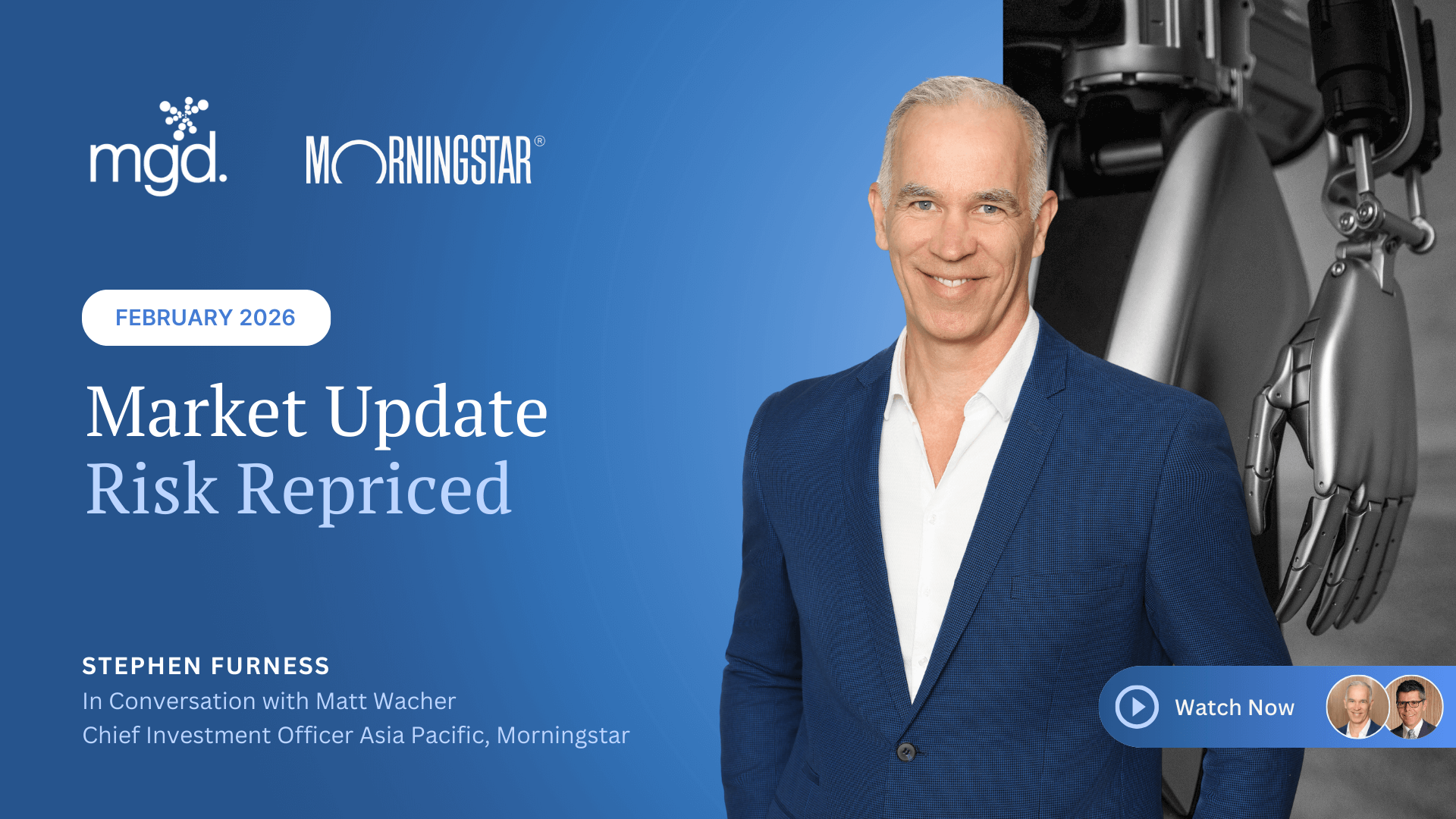
Stephen Furness, Director of MGD Wealth and Chair of the Investment Strategy Group, is joined by Matt Wacher, Chief Investment Officer for Asia Pacific at Morningstar Investment Management.
Our February 2026 Market Update reflects on a volatile start to the year following strong but uneven returns in 2025. While markets have remained resilient, the conversation focuses on a structural shift now taking place—the rising cost of growth, the return of capital discipline, and a market increasingly willing to reprice risk.
Key Takeaways
Geopolitical risk remains elevated and largely unknowable—reinforcing the need for preparation rather than prediction.
Inflation in Australia has proven persistent—narrowing the Reserve Bank’s policy options and keeping financial conditions restrictive.
Higher bond yields have restored the role of defensive assets and strengthened the case for genuine diversification.
Market leadership is broadening as concentration in US mega-cap technology is tested.
Rising capital expenditure—particularly in AI—is changing the risk and return profile of previously capital-light growth companies.
Volatility Is Transitory—Cost Is Structural
Geopolitical developments early in 2026—spanning Ukraine, Iran, Venezuela and global energy security—have once again heightened volatility. But as Matt Wacher noted, while such events shape sentiment, their outcomes and timing remain unknowable.
For investors, the more enduring issue is not volatility itself, but how markets are now responding to it. Rather than indiscriminate risk-off behaviour, recent market moves reflect increasing scrutiny of fundamentals—particularly where capital intensity is rising and returns are less certain.
What Can Be Known Still Matters
A central theme of the discussion was the importance of focusing on what can be assessed: valuations, cash flows and capital allocation. These factors anchor long-term returns and become more important as uncertainty rises.
Attempting to forecast geopolitical outcomes adds little value. Being prepared—with portfolios built around durable fundamentals—does.
A Strong Year, But a Changing One
The year to December 2025 delivered solid outcomes across diversified portfolios. Growth-oriented strategies generated double-digit returns, while conservative portfolios still achieved meaningful real returns despite volatility.
However, Matt cautioned against assuming recent performance can be repeated. Exceptional three- and five-year returns are unlikely to persist—particularly as financial conditions tighten and capital becomes more expensive.
Australian equities lagged global peers, while international and emerging markets performed more strongly—a sign that market leadership is broadening rather than collapsing.
Inflation, Rates and the Return of Restraint
Inflation remains a key constraint. In Australia, expectations for rate cuts gave way to renewed concern as price pressures proved sticky—culminating in a rate rise in early 2026.
The Reserve Bank now faces a narrow path: balancing improving economic sentiment against persistent inflation. While further aggressive tightening appears unlikely, policy restraint reinforces a higher hurdle rate across asset classes.
Bonds Matter Again
Rising global bond yields—painful in the short term for conservative investors in 2022—have materially improved portfolio construction. With yields now offering positive real returns, fixed income once again contributes income, diversification and resilience.
Japan’s shift away from long-standing deflation adds further complexity—with implications for global capital flows and market correlations.
Growth Is No Longer Free
Perhaps the most significant shift discussed was the transformation of large technology companies from capital-light businesses into capital-intensive ones.
AI investment has driven an unprecedented surge in capital expenditure—data centres, semiconductors and infrastructure now demand sustained spending. Markets have begun to respond accordingly, reassessing valuations and penalising companies where the return on that capital is uncertain.
This is the point at which the bill arrives. Growth must now justify its cost.
Broadening Opportunity, Higher Standards
As concentration eases, opportunities are emerging beyond US mega-cap technology. Matt highlighted areas such as healthcare, select consumer businesses and globally recognised brands trading at depressed valuations.
The environment does not argue for retreat from risk, but for selectivity. The bar for returns is higher, dispersion is increasing, and capital discipline matters again.
Positioning for the Next Phase
Markets are not signalling crisis. They are signalling consequence.
By focusing on valuation, capital allocation and diversification—and by resisting the temptation to chase the most crowded trades—investors are better positioned to navigate a market where growth is harder, capital is dearer, and discipline is rewarded.
For any questions or to discuss your portfolio, reach out to your MGD Wealth advisory team.
Important Note: Stephen Furness is a Representative of MGD Wealth Ltd. AFSL 222600, ABN 53 009 079 725. The information in this article is current as of 10 February 2026. Please note that past performance is not an indication of future performance. Any advice included in this article is general and has been prepared without considering your objectives, financial situation or needs. As such, you should consider its appropriateness having regard to these factors before acting on it. Before you make any decision about whether to acquire a certain financial product, you should obtain and read the relevant product disclosure statement.